
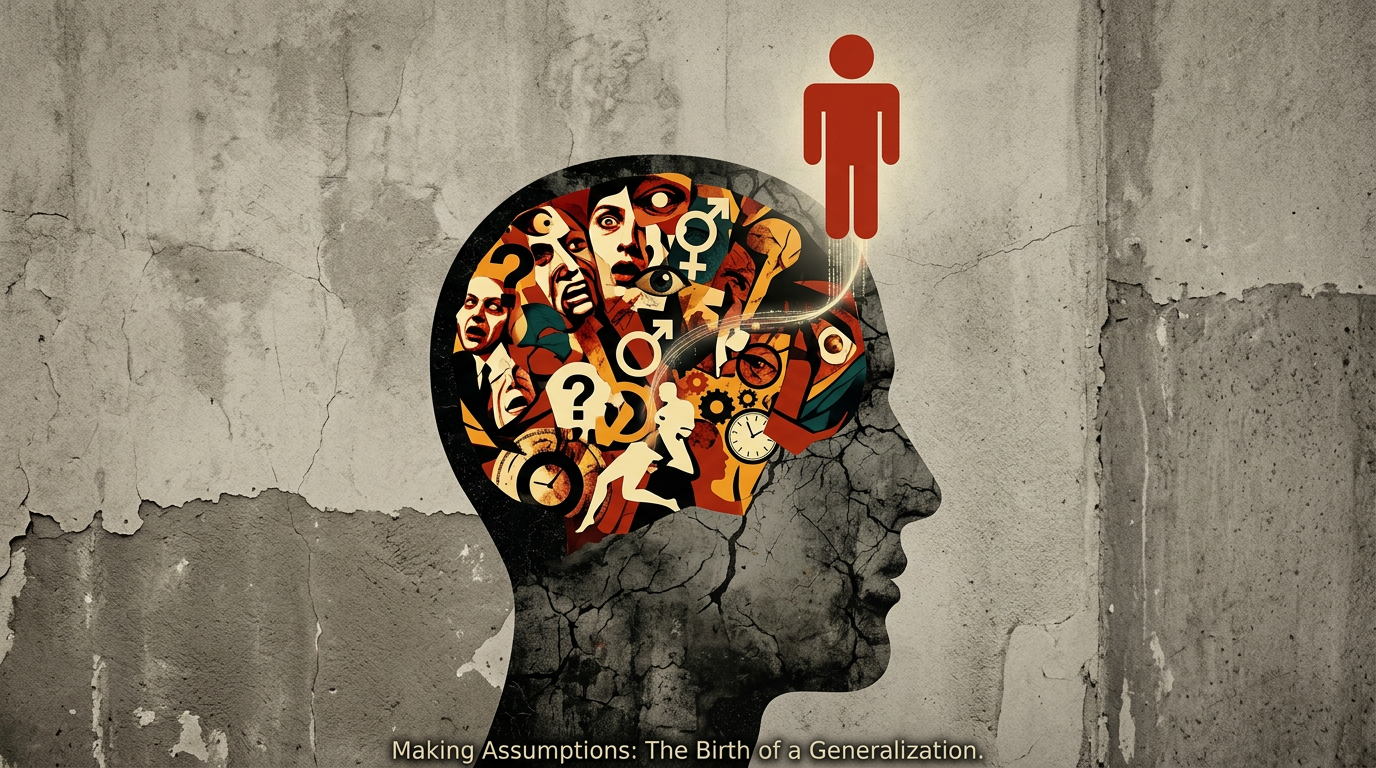


A Functional Look Through the Dynamic Interpersonal Model
People often assume my frustration with assumptions is personal — a quirk, a preference, a pet peeve. But it’s not personal at all. It’s structural.
Assumptions and generalizations violate the very architecture my mind, my work, and the Dynamic Interpersonal Model are built on. They collapse complexity into caricature. They replace curiosity with certainty. They flatten living systems into static labels.
And for someone who has spent a lifetime navigating scarcity — and nearly two decades in higher education trying to articulate what I could feel long before I could name — that collapse is more than annoying. It’s destabilizing. It’s inaccurate. And it’s unnecessary.
This post is my attempt to finally put words to something I’ve known intuitively for years: Assumptions and generalizations are the opposite of how my brain works — and the opposite of what the model teaches.
Assumptions Collapse Complexity — and My Work Is About Preserving It
The Dynamic Interpersonal Model is built on a simple but radical premise:
People are not roles. Roles are functions. And functions shift with context.
Assumptions do the opposite. They take a dynamic system and freeze it. They take a functional role and turn it into an identity. They take a momentary state and treat it like a permanent trait.
My brain doesn’t work that way. My model doesn’t work that way. Human beings don’t work that way.
When someone assumes they “know” what I mean, what I feel, or what I intend, they’re not just wrong — they’re violating the functional logic of the system itself.
Scarcity Taught Me to Track Signal, Not Noise
Growing up in scarcity — emotional, financial, relational, systemic — trains you to read the world with precision. You learn to track micro‑shifts. You learn to distinguish threat from misunderstanding. You learn to see patterns long before others notice them.
Assumptions are noise. Generalizations are noise. They obscure the very signals I’ve spent a lifetime learning to detect.
My brain was shaped in environments where misreading a situation had consequences. So now, when someone defaults to assumption, it feels like watching someone contaminate clean data. It’s not about irritation. It’s about integrity.
Assumptions Erase Agency — and Agency Is Central to the Model
In the model, roles are adaptive responses to scarcity:
- Fight → Villain
- Flight → Victim
- Freeze → Bystander
- Fix → Hero
These are not identities. They are not diagnoses. They are not moral categories.
They are functional states of the autonomic nervous system.
Assumptions turn these states into judgments. Generalizations turn these functions into character flaws.
When someone says, “You’re being dramatic,” or “You always do this,” or “People like you…” — they’re not describing behavior. They’re erasing agency.
The model exists to restore that agency. Assumptions undermine it.
Misrepresentation Has Been a Repeated Injury
This part is simple: I’ve been misunderstood before. I’ve been flattened before. I’ve been interpreted through someone else’s lens instead of my own.
And when you spend years building a model that is fundamentally about accurate representation of internal states, misrepresentation hits differently.
It’s not about ego. It’s about fidelity.
Assumptions feel like a shortcut through the very terrain I’ve spent my life mapping.
My Brain Works in Layers — Assumptions Work in Lines
My thinking is layered. My writing is layered. My model is layered.
Assumptions are linear. Generalizations are linear.
They skip the middle. They skip the nuance. They skip the context.
They take a multidimensional system and reduce it to a single axis.
My brain refuses to do that. My work refuses to do that. And my model refuses to do that.
The Model Itself Is an Antidote to Assumptions
The Dynamic Interpersonal Model teaches:
- Context matters.
- State matters.
- History matters.
- Function matters.
- Language matters.
- Nervous system patterns matter.
Assumptions ignore all of these.
Generalizations erase all of these.
The model is a practice of returning to presence — of seeing what is actually happening rather than what we expect to happen. It is a discipline of noticing without collapsing. It is a commitment to staying with complexity long enough for truth to emerge.
Assumptions are the opposite of that discipline.
So Why Is This My Biggest Pet Peeve?
Because assumptions and generalizations violate the core commitments of my life, my work, and my model:
- They collapse complexity.
- They contaminate signal.
- They erase agency.
- They repeat old injuries.
- They flatten layered systems.
- They undermine the functional logic of the model.
And because after a lifetime of scarcity — and 17 years of trying to find the language for how my mind works — I finally have a framework that explains it.
Assumptions aren’t just inaccurate. They’re incompatible with the way I see the world.
And the model gives me the language to finally say so.

Discover more from Themodel.Global
Subscribe to get the latest posts sent to your email.
