
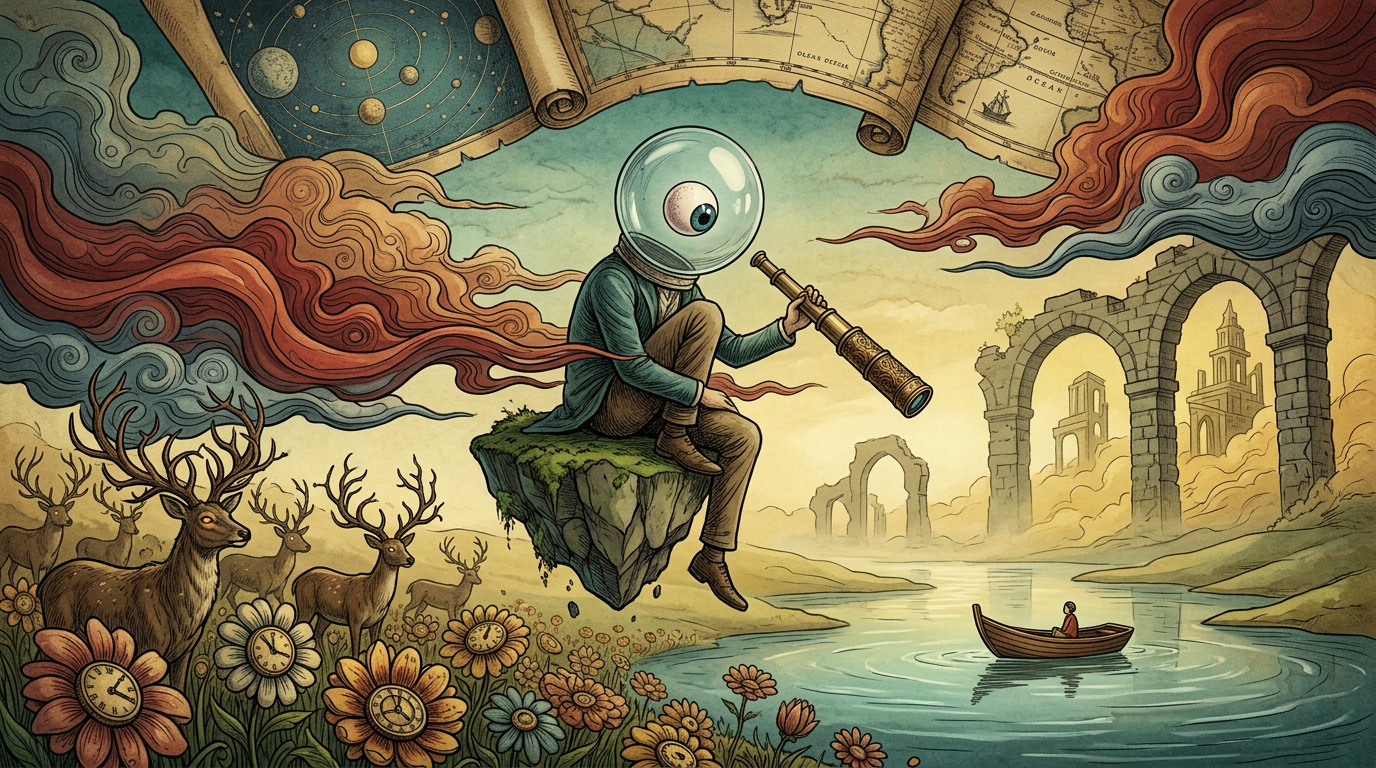


The Role That Holds the Field
Observer is the abundance role that emerges when someone can stay present without intervening, collapsing, freezing, or controlling. It’s the role that holds the field steady. It’s the role that sees clearly without needing to fix, withdraw, disappear, or dominate.
If Heroism is the frantic attempt to restore order, Observerhood is the capacity to remain in contact with reality as it is.
Observer is:
- grounded presence
- emotional regulation without suppression
- clarity without detachment
- attunement without absorption
- witnessing without withdrawal
- participation without taking over
It is the abundance counterpart to Bystanderhood — but where the Bystander steps back to avoid impact, the Observer steps back to perceive impact.
The Core Tension of Observerhood
Every abundance role has a tension.
For the Observer, the tension is:
How do I stay present without becoming responsible for the outcome.
This is one of the hardest things for humans to do.
Most people either:
- collapse into the field (scarcity), or
- rise above it (over‑abundance)
Observerhood is the rare middle path.
The Psychological Engine of Observerhood
Observerhood is powered by:
- emotional regulation
- curiosity
- humility
- tolerance for ambiguity
- the ability to hold multiple truths
- the capacity to witness without absorbing
It’s the role that can say:
“I see what’s happening. I’m here. I’m not overwhelmed. And I’m not taking over.”
This is why the Villain finds the Observer so disorienting — the Observer doesn’t collapse, doesn’t escalate, and doesn’t reorganize. They simply remain themselves.
How Observerhood Organizes the Scarcity Roles
Observerhood stabilizes the entire scarcity system:
With the Villain
The Observer doesn’t react, retreat, or submit. They hold their center. This disrupts the Villain’s intensity without shaming it.
With the Victim
The Observer doesn’t rescue or minimize. They witness the pain without absorbing it. This allows the Victim to feel seen without being taken over.
With the Hero
The Observer is the one presence the Hero cannot “fix.” This forces the Hero to confront their own anxiety and slow down.
With the Bystander
The Observer models what distance looks like when it’s grounded rather than avoidant. It invites the Bystander back into relational contact.
Observerhood re‑regulates the entire scarcity system simply by staying present.
How Observerhood Organizes the Abundance Roles
The Observer is the abundance role that keeps the other abundance roles from inflating.
Creator
The Observer keeps the Creator from becoming self‑inflated or self‑referential. It grounds creativity in reality.
Challenger
The Observer keeps the Challenger from becoming righteous. It adds nuance and humility.
Mentor
The Observer keeps the Mentor from becoming a guru. It restores reciprocity.
Observer
And yes — the Observer keeps itself from drifting into detachment. It stays in contact with the relational field.
Observerhood is the abundance role that prevents over‑abundance.
The Shadow of Observerhood: The Detached Analyst
Every abundance role has a distortion.
For the Observer, the shadow is detached analysis — the person who confuses neutrality with wisdom and detachment with presence.
This is where pop‑culture mindfulness becomes the mindfulness-trap.
Story: “Nick Learns to Breathe”
Nick started meditating because he was tired of feeling anxious. The apps made it look simple: breathe, observe, detach. Within a few weeks, he felt calmer. Within a few months, he felt almost serene.
His partner, Rowan, noticed the change with relief at first. Nick wasn’t spiraling. He wasn’t catastrophizing. He wasn’t pacing the house at 2 a.m.
But something else was happening too — something quieter.
Whenever Rowan brought up something difficult, Nick would close his eyes, inhale slowly, and say, “I’m just noticing my reaction.” Whenever Rowan expressed frustration, Nick would respond, “I’m choosing not to engage with negativity.” Whenever Rowan asked for more emotional presence, Nick would say, “I’m practicing non‑attachment.”
It sounded enlightened. It felt like absence.
One night, Rowan said, “I feel like you’re not here with me anymore.”
Nick smiled gently — the kind of soft, serene smile he’d learned from meditation videos — and said, “I’m here. I’m observing everything.”
But he wasn’t. He was watching Rowan cry the way someone watches rain on a window — noticing the pattern, appreciating the movement, but never stepping outside.
Rowan finally said, “I don’t need you to observe me. I need you to be with me.”
Nick felt a flicker of panic — the very feeling he had been training himself not to feel. He took a breath to push it down, but Rowan stopped him.
“Don’t breathe it away,” they said. “Feel it. With me.”
And in that moment, Nick realized:
He had used mindfulness to escape the very thing mindfulness was meant to help him face — his own vulnerability.
He had become calm, but not present. Neutral, but not connected. Still, but not alive.
He had become the Detached Analyst — the shadow of the Observer.
The Healing Arc of Observerhood (What True Observer Looks Like)
The Observer’s growth edge is not to become more detached. It’s to become more in contact.
The Observer heals by remembering:
- presence is not neutrality
- clarity is not distance
- regulation is not withdrawal
- stillness is not escape
- witnessing is not watching from afar
Presence is participation. Presence is impact. Presence is relationship.
Story: “Mira Stays in the Room”
Mira’s younger sister, Dani, had always been the emotional one — quick to cry, quick to spiral. When Dani called one night in tears, Mira felt her own chest tighten. The old impulse rose immediately: fix it, soothe it, solve it.
But Mira had been working on something different. Not detachment. Not neutrality. Not “mindfulness” as escape.
Presence.
So she took a breath — not to make the feeling go away, but to make room for it.
Dani said, “I don’t know what to do. Everything feels like too much.”
Mira didn’t offer advice. She didn’t minimize. She didn’t intellectualize.
She said, “I’m here. Tell me what’s happening.”
Dani talked in circles. She cried. She apologized for crying. She said she felt stupid.
Mira stayed with her.
Not above her. Not outside the moment. Not analyzing it.
With her.
When Dani said, “I’m scared,” Mira said, “Yeah. I can feel that. I’m right here.”
When Dani said, “I don’t know what to do,” Mira didn’t rush to fill the silence. She let the silence breathe. She let Dani breathe. She let herself breathe.
And in that space — not forced, not engineered, not controlled — Dani found her own next step.
Later, Dani said, “I don’t know what you did, but it helped.”
Mira smiled. “I didn’t do anything,” she said. “I just stayed.”
That is Observerhood.
Observerhood Is the Ground of Choice
When we are in a scarcity role, choice collapses:
- The Villain must attack.
- The Victim must collapse.
- The Bystander must freeze.
- The Hero must fix.
Observerhood is the return of choice.
It is the moment we can feel the pull of the role and still say:
“I have other options.”
From here, we can move toward Mentor, Challenger, or Creator — not as performances, but as genuine relational capacities.
Closing Metaphor: The Earth That Knows How to Hold
Observerhood is the earth — the living ground beneath everything that moves across it.
The earth is steady, but not still. It shifts with the seasons, softens with rain, settles after storms. It lets roots press into it, lets rivers carve through it, lets wind lift its dust and fire change its surface.
It is shaped — and it shapes in return.
The earth doesn’t cling to what touches it. It doesn’t resist the elements. It doesn’t try to control their movement.
It simply offers itself as the place where everything can land.
Air moves — bringing clarity and confusion, spreading both stillness and storms. The earth breathes and lets the movement shape it, meeting the wind without chasing it or turning away.
Fire burns — bringing heat and impetus, offering the spark that pushes life. The earth responds by cracking, hardening, or opening, feeling the intensity without being consumed by it.
Water flows — bringing change and renewal, creating possibilities and paths as it moves. The earth yields just enough to guide it, without trying to contain it or let it wash the world away.
The earth is not untouched by any of this. It is touched by all of it.
And still, it remains the ground.
This is Observerhood:
The presence that lets things be what they are while staying fully in relationship with them.
The ground that feels everything and still knows how to hold.
Discover more from Themodel.Global
Subscribe to get the latest posts sent to your email.
