
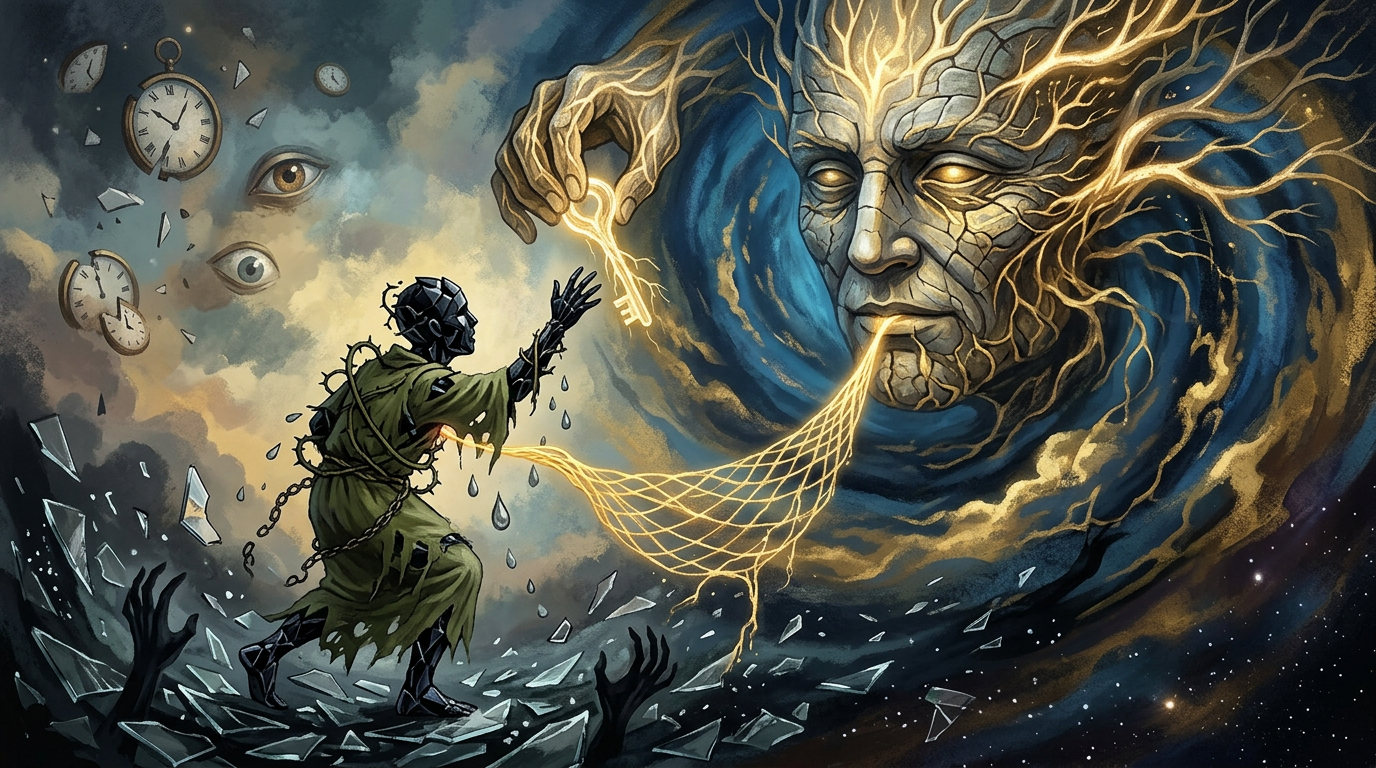


In this article I look at all the healthy and unhealthy dynamics between a mentor and a victim – particularly what kinds of dynamics occur when either move through scarcity or abundance.
🌿The Healthy / Abundance Dynamics
1. Regulation Meets Dysregulation
- The Mentor’s nervous system is in a regulated, perspective‑holding state.
- The Victim is in flight physiology — overwhelmed, collapsed into “I can’t,” scanning for safety.
Healthy dynamic: The Mentor’s regulation becomes co-regulatory scaffolding rather than takeover. They don’t fix. They don’t rescue. They don’t override. They offer orientation, perspective, and choice.
This looks like:
- “You’re not alone; let’s slow the moment down.”
- “You still have options; let’s find one that feels doable.”
- “Your overwhelm makes sense; you don’t have to solve everything right now.”
The Victim’s system feels:
- Seen without being infantilized
- Supported without being carried
- Oriented without being directed
This is the ideal abundance–scarcity bridge in the model.
2. Agency is Reintroduced, Not Imposed
The Mentor’s core function is restoring agency.
Healthy dynamic:
- They offer choice architecture, not solutions.
- They invite participation, not dependence.
- They trust the Victim’s capacity even when the Victim can’t feel it.
This is the moment where the Victim begins to shift toward Creator — not because the Mentor “taught” them, but because the Mentor held a regulated stance long enough for the Victim’s system to re‑access possibility.
3. The Relationship is Non‑Hierarchical
The Mentor is not above. The Victim is not below.
Healthy dynamic:
- The Mentor shares perspective, not authority.
- The Victim receives support without losing dignity.
This preserves the non‑moralized, non‑hierarchical nature of the model.
🔥 The Distorted / Scarcity Dynamics
This is where things get interesting — because the Mentor role can collapse under pressure into Hero, and the Victim role can collapse into deeper helplessness or even resentment.
1. Mentor → Hero (Fix)
If the Mentor slips into:
- urgency
- over‑functioning
- “let me help you avoid pain”
- “I know what you should do”
…they’re no longer in abundance. They’ve dropped into Fix physiology (Hero).
This creates:
- Dependency
- Disempowerment
- A subtle hierarchy
- The Victim feeling “small,” “incompetent,” or “like a burden”
The Victim’s system may respond with:
- Gratitude mixed with shame
- Relief mixed with collapse
- Compliance mixed with resentment
This is the classic rescuer–helpless loop the model avoids by design.
2. Victim → Deeper Collapse
If the Victim senses:
- pressure to improve
- pressure to be grateful
- pressure to “use the help well”
- pressure to regulate faster than they can
…their system may collapse further into:
- “I can’t”
- “I’m failing even at being helped”
- “You’re better than me”
- “I’m too much”
This is not a moral failure — it’s a flight physiology intensifying under perceived demand.
3. Mentor’s Wisdom Becomes Distance
If the Mentor becomes:
- too conceptual
- too perspective‑heavy
- too “above the fray”
- too serene
…the Victim may feel:
- unseen
- minimized
- emotionally abandoned
- like their pain is being bypassed
This is the shadow of the Mentor: wisdom without attunement becomes dismissive.
4. Victim May Project Villain or Bystander Onto the Mentor
Depending on the Victim’s history and physiology:
- The Mentor’s boundaries may feel like abandonment (Bystander projection).
- The Mentor’s clarity may feel like control (Villain projection).
- The Mentor’s calm may feel like disconnection.
This is not pathology — it’s the Victim’s ANS interpreting relational cues through a scarcity lens.
🌱 The Core Pattern: Mentor Offers Space; Victim Fears It
Healthy dynamic:
- Space = possibility.
Distorted dynamic:
- Space = abandonment.
- Guidance = pressure.
- Trust = expectation.
- Perspective = minimization.
The difference is attunement, not content.
⭐ The Most Important Insight
A Mentor–Victim pairing is only healthy when the Mentor:
- stays regulated
- stays relational
- stays non‑directive
- stays attuned
- stays humble
- stays present
And when the Victim:
- is allowed to be dysregulated
- is not rushed toward agency
- is not shamed for collapse
- is not treated as fragile
- is not rescued
This is the bridge between scarcity and abundance in the model — the moment where physiology, relational stance, and meaning-making all converge.
Victim → Villain (Agency Through Power, Not Through Voice)
A shift from collapse to control.
This is a very different phenomenon than Victim → Challenger (described below). Here, the system is not reclaiming agency through grounded truth or boundary. It is reclaiming agency through power, intensity, and control.
In the model, this is Flight → Fight, but with the fight energy organized around domination rather than assertion.
It is not pathology. It is a functional survival strategy.
🌿 How the Mentor Experiences a Victim Becoming a Villain (Healthy Interpretation)
1. A Sudden Surge of Power in the System
The Mentor feels the person “come online,” but with sharper edges.
It’s not:
- clarity
- collaboration
- mutuality
It’s:
- force
- intensity
- push
The Mentor senses the person is no longer collapsed — but they are also not relationally available.
2. A Shift From Seeking Safety to Asserting Control
The Victim is no longer looking for protection. They are now trying to protect themselves by taking power.
The Mentor experiences:
- pressure
- challenge
- emotional heat
- a sense of being pushed back
This is not partnership. It’s defensive dominance.
3. The Villain’s Energy Feels Directed At the Mentor
Unlike the Challenger, who directs energy toward truth, the Villain directs energy toward the other person.
The Mentor may feel:
- accused
- blamed
- misinterpreted
- overpowered
Even if the Mentor is regulated, the Villain stance can feel like a relational attack.
4. The Mentor Feels the Loss of Mutuality
The Victim-as-Villain is not joining. They are defending.
The Mentor experiences:
- distance
- hierarchy
- threat
- a collapse of collaboration
This is the moment where the Mentor must stay grounded to avoid slipping into Hero, Bystander, or defensive Villain.
🔥 What the Villain Looks Like (Functional, Not Moral)
1. Power Without Perspective
- “You’re wrong.”
- “You don’t get it.”
- “You’re making things worse.”
This is not truth-telling. It’s control.
2. Boundary as Weapon, Not Clarity
- “Back off.”
- “Stop talking to me like that.”
- “You’re not helping.”
The tone is:
- sharp
- protective
- dominating
3. Agency Through Force, Not Through Voice
The Villain stance is the system saying:
“I refuse to feel small — so I will make myself big.”
It is a fight response used to escape the humiliation of collapse.
🌱 How the Mentor Responds (Abundance)
A grounded Mentor recognizes:
- this is not personal
- this is not moral
- this is not characterological
It is physiology.
The Mentor stays:
- regulated
- non-defensive
- attuned
- present
They do not:
- explain
- justify
- overpower
- withdraw
Instead, they hold the relational field steady until the Villain energy softens enough for the person to return to connection.
🌩️ What If the Mentor Feels Challenged or Attacked?
Even in abundance, the Mentor may feel:
- startled
- pushed
- misunderstood
- pressured
But they interpret the Villain stance as:
- a bid for safety
- a reaction to shame
- a defense against collapse
- a temporary survival strategy
Not as a betrayal of the relationship.
⭐ The Deep Insight
When a Victim becomes a Villain, the Mentor experiences:
a surge of power that protects the person from feeling small — but also pushes the relationship into a hierarchy.
It is not the return of agency through truth (Challenger). It is the return of agency through control.
And the Mentor’s task is to:
- stay steady
- stay relational
- stay non-reactive
- stay non-hierarchical
So the person can eventually shift back toward connection and possibility.
Victim → Challenger (Agency Reclamation)
*Not Villain. Not fight. Not domination.
A return to self.*
This is the moment where the Victim’s system says:
“I’m done collapsing. I’m done feeling small. I’m ready to stand up.”
It’s a flight → fight shift, yes — but not in the sense of aggression. It’s the nervous system rediscovering voice, boundary, truth, and presence.
This is the birth of agency.
And the Mentor experiences it very differently than a Villainic pushback.
🌿 How the Mentor Experiences a Victim Becoming a Challenger (Healthy)
1. A Surge of Energy Returning to the System
The Mentor feels the person “come online” again.
It’s like:
- the lights turn back on
- the person re-enters the room
- the collapse lifts
- the voice strengthens
The Mentor experiences this as engagement, not threat.
2. A Shift Toward Mutuality
The Victim is no longer looking up at the Mentor. They’re looking with them.
The Mentor feels:
- relief
- connection
- partnership
- shared responsibility
This is the moment where the relationship becomes two-sided again.
3. The Challenger’s Energy Feels Directed Toward Truth, Not Toward the Mentor
The Mentor senses:
- clarity
- honesty
- grounded pushback
- a desire to participate
It’s not “you’re wrong.” It’s “I’m here now, and I have something to say.”
4. The Mentor Feels Invited Into Dialogue
The Victim-as-Challenger is not attacking. They’re joining.
The Mentor experiences:
- curiosity
- respect
- a sense of being met
- a sense of being needed differently
This is the moment where the Mentor can relax their scaffolding because the other person is standing again.
🔥 What the Challenger Looks Like (Healthy)
1. Boundary Without Blame
- “Actually, that doesn’t feel right to me.”
- “I need something different here.”
- “Let me tell you how it lands on my side.”
This is not defiance. It’s self-definition.
2. Truth Without Attack
- “I hear you, but my experience is…”
- “I want to push back on that.”
- “I’m not helpless — I’m overwhelmed.”
This is the Challenger’s gift: naming reality without harming the relationship.
3. Agency Without Aggression
The tone is:
- firm
- clear
- grounded
- present
Not sharp. Not defensive. Not escalating.
🌱 How the Mentor Responds (Abundance)
A true Mentor welcomes this shift.
They feel:
- proud
- relieved
- connected
- less responsible
- more collaborative
They may even think:
“Yes. There you are.”
Because the Mentor’s whole purpose is to support the return of agency — not to maintain a position of wisdom or calm.
🌩️ What If the Mentor Feels Challenged?
Even in abundance, the Mentor may feel:
- surprised
- slightly destabilized
- humbled
- invited to adjust
But not threatened.
A healthy Mentor interprets the Challenger’s energy as:
- engagement
- honesty
- relational investment
- a sign of trust
Because the Victim would not risk challenging someone they didn’t trust.
⭐ The Deep Insight
When a Victim becomes a Challenger in a healthy way, the Mentor experiences it as:
the moment the relationship becomes real.
Not hierarchical. Not regulated/unregulated. Not helper/helped.
But two humans in shared truth.
This is the exact arc the model encodes:
- Victim → Challenger is the return of agency.
- Mentor → attuned presence is the holding of space for that agency.
- Together, they create a relational field where abundance becomes possible.
Discover more from Themodel.Global
Subscribe to get the latest posts sent to your email.
