
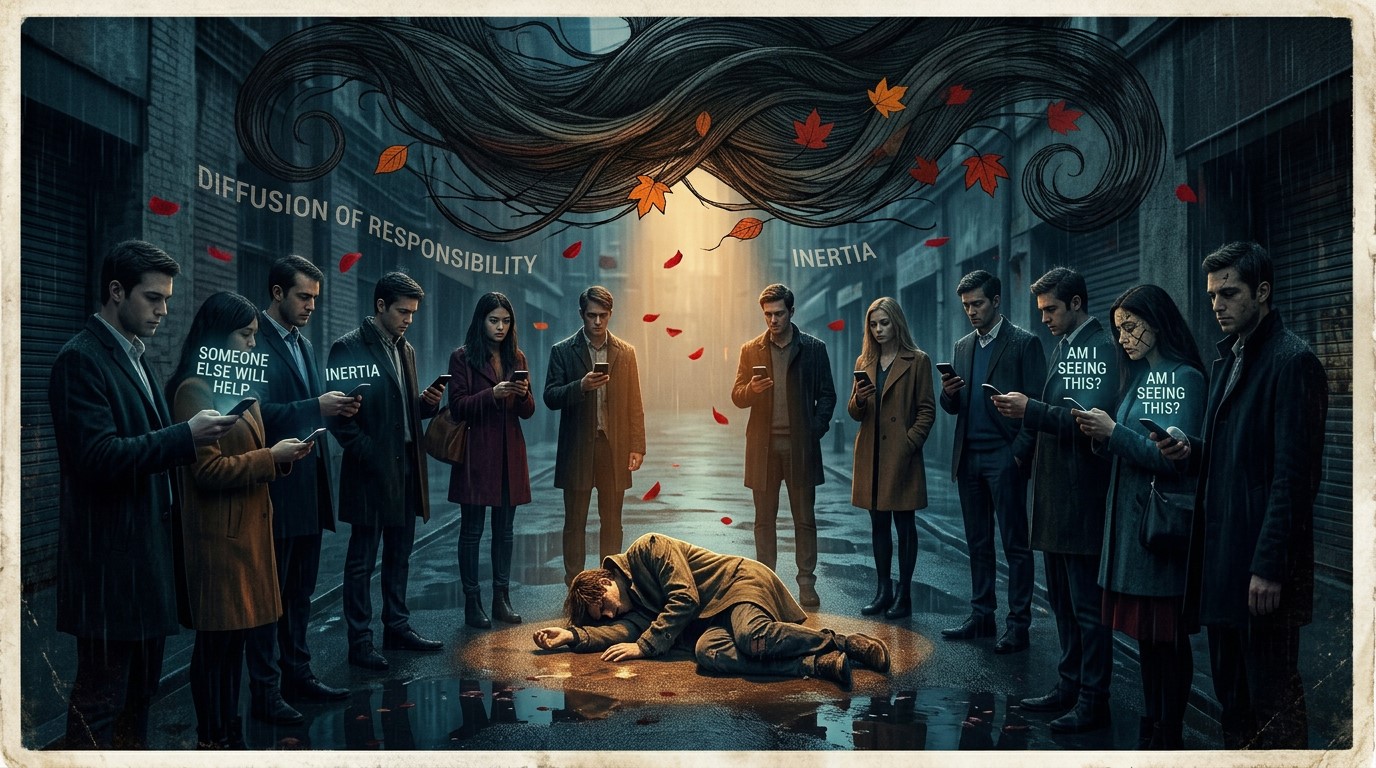


How Freeze Shapes the Interpersonal Field and the Bystander Effect Emerges
Most people don’t realize when they’ve slipped into a pattern of staying quiet. It doesn’t look dramatic. It doesn’t look avoidant. It often looks like something much smaller.
Like this:
Someone raises their voice, and you go still. A friend gets hurt, and you wait for someone else to respond. A boundary is crossed, and you tell yourself, “It’s not my place.”
None of these moments are catastrophic. But together, they create a familiar ache: “I don’t know how to step in without making things worse.”
You start to feel like a ghost in your own relationships. You start to doubt your instincts. You start to wonder if your presence even matters.
And without realizing it, your nervous system begins organizing the entire relational field around this stillness — not because you’re indifferent, not because you don’t care, but because your body is trying to keep you safe in the only way it knows how.
This is the Bystander role in the Dynamic Interpersonal Model. And it is far more common — and far more human — than most people realize.
The Bystander Role as a Scarcity Center
Core scarcity: “If I move, I’ll make it worse. If I speak, I’ll become the problem.”
Freeze is not apathy. It is not neutrality. It is a survival strategy — the body’s attempt to reduce threat by reducing visibility.
But when someone stays in this role, the system reorganizes around their stillness. Not intentionally — structurally.
Their identity coherence depends on the world confirming:
- “I’m safest when I stay quiet.”
- “My presence doesn’t change anything.”
- “Someone else will handle it.”
And so the relational field shifts to support that story.
The Bystander Role: A Nervous System Doing Its Best
Bystander is the scarcity‑side expression of Freeze physiology. It’s not a personality trait or a moral failure. It’s a body doing exactly what it learned to do when activation felt overwhelming.
The body organizes around:
- “Stay small.”
- “Stay still.”
- “Don’t draw attention.”
- “Wait for the danger to pass.”
Freeze is intelligent. Freeze is protective. Freeze is efficient.
But freeze doesn’t stay inside the body. It shapes the entire relational field.
How the Bystander Pulls Scarcity Roles Into the Field
When someone is in Bystander physiology, the people around them often get pulled into complementary scarcity roles — not because they choose to, but because the relational field is trying to stabilize itself.
Villain (Fight)
The person who fills the silence with intensity.
Your stillness becomes the ground onto which they project urgency, frustration, or dominance. Your quiet reads as passivity, which activates their need to take control.
Impact: They feel responsible for “moving things forward,” often with more force than the situation requires.
Victim (Flight)
The person who interprets your stillness as abandonment.
Your quiet becomes “You don’t care.” Your pause becomes “You’re leaving me alone with this.”
Impact: They feel unseen, unsupported, and overwhelmed.
Hero (Fix)
The person who steps in to manage what you don’t.
Your stillness becomes a vacuum they rush to fill. They soothe, mediate, or take responsibility for the emotional tone of the room.
Impact: They feel overextended and quietly resentful.
The Bystander Effect: When Freeze Meets Freeze
Most people think the Bystander Effect is about apathy. In the Dynamic Interpersonal Model, it’s something far more intimate — and far more destabilizing.
It’s what happens when two or more nervous systems slip into Freeze at the same time.
Not because they don’t care. Not because they’re indifferent. But because bodies are trying to stay safe by staying still.
And when that happens, the relational field loses its structure.
What it feels like from the inside
Each person waits for the other to move. Each person waits for the other to speak. Each person waits for the other to name what’s happening.
But no one moves. No one speaks. No one names the harm.
The silence becomes a vacuum — a space where nothing shifts because no one feels safe enough to shift first.
What happens in the system
- No one interrupts the escalation.
- No one reaches for repair.
- No one sets a boundary.
- No one offers support.
- No one signals safety.
The field becomes a still pond with no ripples — a system without momentum, direction, or containment.
The hidden mechanism
Freeze is contagious.
When one person goes still, the other’s nervous system often mirrors it:
- going quiet
- stepping back
- becoming careful
- waiting for a cue that never comes
Two people both trying not to make things worse end up making things nothing — no movement, no repair, no connection.
The emotional impact
Both people walk away feeling:
- unseen
- unsupported
- alone
- confused about why nothing happened
- convinced the other didn’t care
But the truth is simpler and kinder:
Both were overwhelmed. Both were protecting themselves. Both were waiting for a signal of safety that neither could give.
Why this matters for healing
This is why the Bystander’s healing arc is not toward Heroism. Heroism would overwhelm the system.
The healing arc is toward Mentorship — the regulated Fix role — because the Mentor provides:
- steady presence
- gentle guidance
- low‑intensity engagement
- relational safety
- a model of “I can be here without taking over”
Mentorship breaks the Bystander Effect not through force, but through warm, grounded presence.
It gives the relational field the one thing Freeze cannot generate on its own:
a signal that it is safe to move again.
How the Bystander Relates to the Abundance Roles
The abundance roles — the regulated expressions of the same ANS strategies — can feel destabilizing to someone in Bystander physiology.
- Creator (evolved Flight) Feels overwhelming: “You’re moving too fast.”
- Challenger (evolved Fight) Feels threatening: “You’re too direct.”
- Observer (evolved Freeze) Feels confusing: “You’re here… but you’re not stepping in.”
- Mentor (evolved Fix) Feels confronting: “You believe I can do more than I think I can.”
Abundance roles challenge the Bystander’s worldview simply by existing.
Why People Stay Stuck in Bystanderhood
Here is the core truth:
People avoid stepping out of Bystanderhood because they fear becoming the Villain or the Victim.
If your identity is built around:
- “I don’t want to make it worse.”
- “I don’t want to be too much.”
- “I don’t want to cause harm.”
- “I don’t want to be harmed”
Then taking action can feel like:
- overstepping
- intruding
- escalating
- becoming the problem
- becoming the target
This is not psychological stubbornness. It’s identity‑protective physiology.
The Healing Arc: From Bystander → Mentor
The transition from Bystander to Mentor is not a leap. It is a physiological progression.
1. Bystander → micro‑Fix
The first spark of engagement:
- “Are you okay?”
- “Should we pause?”
- “I’m here.”
To the person, this feels like intrusion. But it’s actually Fix at 5% — the first sign of relational presence returning.
2. micro‑Fix → regulated Fix
This is where the system learns:
- support doesn’t equal rescuing
- presence doesn’t equal pressure
- stepping in doesn’t erase boundaries
- care can be steady, not consuming
This is the nervous system discovering that Fix is not inherently overfunctioning.
3. regulated Fix → Mentor
Once the system can tolerate its own presence, the person can:
- step in without taking over
- support without absorbing
- guide without rescuing
- stay steady while others activate
This is the Mentor: Fix energy in service of capacity, not control.
What Makes the Transition Possible
1. Validation of the original fear
The system must know:
- “My stillness made sense.”
- “Freeze kept me safe.”
- “I wasn’t wrong for not knowing what to do.”
Without this, action feels like self‑betrayal.
2. A relational field that stays regulated
If early attempts at engagement are met with:
- intensity (Villain)
- collapse (Victim)
- overfunctioning (Hero)
the system retreats.
3. Titration, not transformation
Small acts of presence teach the body:
- “I can step in without taking over.”
- “I can support without disappearing.”
- “I can be here without becoming the problem.”
Closing
Bystanderhood is the quietest form of suffering in the scarcity system — because it looks like calm. It looks like neutrality. It looks like steadiness. But beneath the surface, the Bystander is holding back more than anyone can see. Their stillness is not indifference; it is protection. Their silence is not apathy; it is overwhelm. Their distance is not a lack of care; it is a body trying not to make things worse. The healing of the Bystander is not in speaking louder, acting faster, or forcing themselves into visibility. Their healing is in discovering that presence does not equal pressure, that engagement does not equal intrusion, and that stepping in does not make them the problem. When the Bystander becomes the Mentor, the entire relational field shifts. Stillness becomes steadiness. Silence becomes attunement. Distance becomes grounded presence. And the Bystander finally discovers what they were trying to create all along: a field where movement is safe, connection is possible, and no one has to wait alone in the dark.
Metaphor — The Thaw
Bystanderhood is like being caught in a long winter inside your own body. Everything feels still. Everything feels muted. Everything feels held in place by a cold you didn’t choose.
You don’t move because movement feels brittle. You don’t speak because your voice feels far away. You don’t reach out because your instincts are wrapped in frost.
So you wait. You conserve. You stay quiet, hoping the world will warm before you do.
But healing doesn’t ask you to break the ice or force yourself into motion. It asks for something far smaller, far kinder:
A little warmth. A little softening. A little melt around the edges.
And when the thaw begins, it’s subtle. Sensation returns. Color returns. Presence returns.
You realize you can move without shattering. You can speak without overwhelming. You can step in without becoming the problem.
This is the Mentor — not a rescuer, not a hero, but a steady warmth that helps the whole field thaw.
The Bystander doesn’t transform through force. They transform through gentle reanimation — the slow, safe return of movement, connection, and relational presence.
Discover more from Themodel.Global
Subscribe to get the latest posts sent to your email.
