
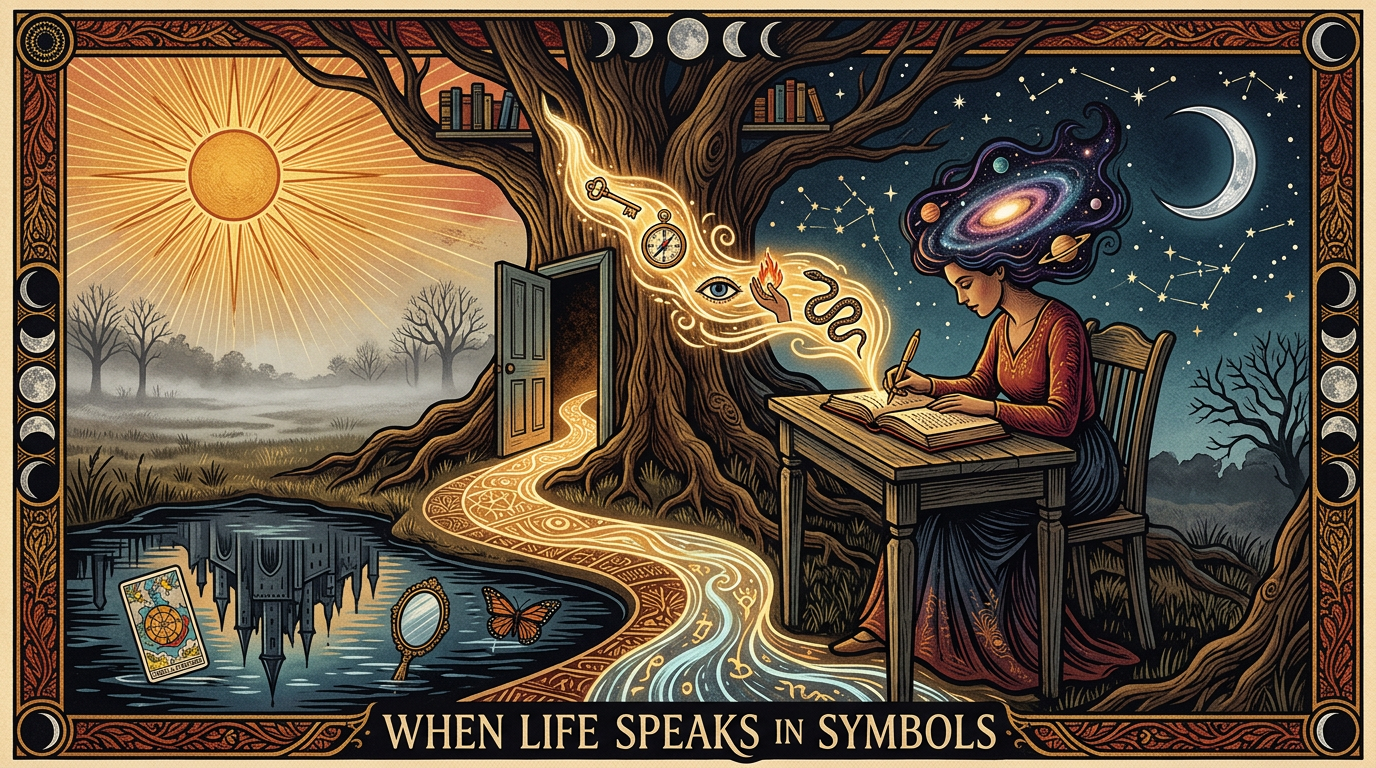


Understanding the Patterns That Shape You
Most of us grow up believing our lives are made of literal events — what happened, what didn’t, what we survived, what we learned. But beneath the surface of every life, there’s another layer quietly shaping who we become:
the symbolic layer.
In the Dynamic Interpersonal Model (DIM), we talk about the roles we inhabit — Villain, Victim, Bystander, Hero — and the Abundance roles we can shift into — Creator, Challenger, Mentor, Observer. These roles aren’t random. They’re symbolic identities shaped by lived experience. And when we learn to listen to the symbolic layer, our lives begin to make sense in ways they never have before.
The Literal Layer: What Happened
The literal layer is the one we’re taught to focus on: the childhood we had; the relationships we formed; the losses we endured; the trauma we survived; the choices we made; the work we’ve done…
In DIM, this is the Locate step — identifying the concrete reality of what shaped us.
But it’s not the whole story.
The Symbolic Layer: What It Meant
Every literal experience creates a symbolic echo — a role, an identity, a pattern.
A child who grows up unseen may become “the invisible one” (Bystander).
A child who grows up protecting others may become “the guardian” (Hero/Fix).
A child who grows up in chaos may become “the stabilizer” or “the storm” (Villain/Fight or Hero/Fix).
A child who grows up alone may become “the tower” (Victim/Flight).
A child who grows up navigating danger may become “the pattern-reader” (Bystander).
These aren’t fantasies. They’re psychological identities — roles our nervous systems learned to play long before we had language for them.
In DIM, this is the Naming step — recognizing the symbolic role we’ve been inhabiting.
And here’s the part most people never realize:
Your symbolic identity is often the clearest map of your strengths.
Why Symbols Show Up Before Language
Children express truth symbolically long before they can express it verbally.
They draw storms when they feel overwhelmed. They draw suns when they feel safe. They draw monsters when they feel threatened. They draw themselves tiny when they feel powerless. They draw themselves huge when they feel responsible. The symbol comes first. The meaning comes later.
Meanwhile, the symbol stays with us — sometimes for decades — waiting for us to understand it. In DIM terms: the symbolic layer is the role we learned to inhabit before we had the words for it.
Why Symbolic Identities Persist Into Adulthood
Symbolic identities don’t disappear when childhood ends. They become the unconscious architecture of adulthood.
The nervous system keeps using the symbol because:
- it worked
- it kept you safe
- it organized chaos
- it made sense of what had none
- it gave you a role when no one gave you a place
Symbols are efficient. They’re fast. They’re embodied. Long before we had language, the symbol told us how to move through the world: Be the storm. Be the tower. Be the guardian. Be the invisible one. Be the pattern‑reader. And because these identities were formed in the body — not the mind — they persist. Not because we’re stuck. But because the symbol became familiar. The symbolic identity is the nervous system’s first story about who we are. And until we name it, it keeps telling itself.
Your Symbolic Identity Isn’t a Wound — It’s a Compass
Many of us assume our symbolic identities are flaws:
“I’m too intense.”
“I’m too sensitive.”
“I’m too protective.”
“I’m too independent.”
“I’m too analytical.”
“I’m too much.”
“I’m not enough.”
But what if those traits aren’t flaws at all? What if they’re adaptations? What if they’re strengths that were born in difficult places? What if the symbol you’ve carried your whole life is actually the clearest expression of who you are? In DIM, this is where we shift — recognizing that the role you learned in scarcity can evolve into a role rooted in abundance.
The Villain is also the Challenger.
The Victim is also the Creator.
The Bystander is also the Observer.
The Hero is also the Mentor.
Your symbolic identity isn’t a cage. It’s a doorway.
How Symbolic Identities Mislead Us (When We Don’t Recognize Them)
A symbolic identity is powerful — but when it goes unnamed, it becomes distorted.
The storm believes intensity is truth.
The tower believes distance is safety.
The guardian believes responsibility is love.
The invisible one believes neutrality is protection.
The pattern‑reader believes clarity is control.
These identities aren’t wrong. They’re just incomplete.
They were built for a different context — a childhood environment that required them. But when we carry them into adulthood without awareness, they start to misguide us:
- We overuse strengths until they become liabilities.
- We mistake old adaptations for current reality.
- We reenact roles that no longer fit the moment.
- We interpret others through the lens of our symbol instead of the present.
- We confuse survival strategies with personality.
Naming the symbol doesn’t destroy it. It frees it.
How Trauma Shapes Symbolic Identity (Without Defining You)
Trauma doesn’t just wound us. It reorganizes us.
It teaches the nervous system how to survive when the world is too much, too fast, too unpredictable, or too empty. And because the body learns faster than the mind, these lessons become symbolic identities long before they become conscious stories.
Trauma teaches us to:
- read emotional cues with precision
- anticipate rupture before it happens
- track patterns others don’t see
- sense danger in the smallest shifts
- understand people deeply and quickly
- create meaning where there was none
- build an inner world when the outer world wasn’t safe
These adaptations become symbols — and those symbols become roles:
the healer (Mentor)
the protector (Hero/Fix → Mentor)
the observer (Bystander → Observer)
the truth‑teller (Villain → Challenger)
the pattern‑breaker (Villain → Challenger)
the stabilizer (Hero/Fix → Mentor)
the storm (Villain/Fight → Challenger)
the rebuilder (Victim → Creator)
These roles weren’t chosen. They were formed — shaped by necessity, repetition, and the body’s need for coherence.
But here’s the part most people miss:
Trauma shapes symbolic identity, but it doesn’t define it.
The symbolic identity is the first draft of who you became in order to survive. It is not the final version of who you are allowed to become. Trauma gives you the raw material — sensitivity, intensity, vigilance, insight, resilience, depth — but abundance gives you the context to refine it. The storm can become direction. The tower can become clarity. The guardian can become guidance. The invisible one can become presence. The rebuilder can become creation.
Trauma may have shaped the symbol, but you get to shape what it becomes.
How Symbolic Identities Evolve Into Abundance Roles
Every symbolic identity has an abundance expression — a way it transforms when it’s no longer driven by fear, scarcity, or survival. But the shift isn’t about becoming someone new. It’s about becoming more yourself than the survival version ever allowed.
Symbolic identities evolve when three things happen — the same three movements that define abundance:
- Presence returns. The nervous system stops bracing. The body no longer needs the old strategy to stay safe.
- Context reorganizes. The environment changes, and the child’s role is no longer required. You can finally see where you are, not just where you came from.
- Intention emerges. Meaning-making becomes movement — shaping values, goals, aspirations, and direction. The symbol stops being a shield and becomes a compass.
When these conditions meet, the symbolic identity doesn’t disappear — it matures.
The storm becomes the Challenger — intensity with direction.
The tower becomes the Observer — distance with clarity.
The guardian becomes the Mentor — responsibility with trust.
The invisible one becomes the Witness — neutrality with presence.
The rebuilder becomes the Creator — resilience with agency.
The pattern‑reader becomes the Mentor — insight with humility.
The stabilizer becomes the Mentor — steadiness with perspective.
The truth‑teller becomes the Challenger — honesty with integrity.
Each transformation follows the same arc — the abundance triad in motion:
Presence → Context → Intention
reactive → intentional protective → generative isolating → relational rigid → adaptive self‑protective → self‑expressive
When a symbolic identity evolves, it moves in a few recognizable ways:
- from reactive to intentional — you stop bracing and start choosing
- from protective to generative — you stop guarding and start creating
- from isolating to relational — you stop withdrawing and start participating
- from rigid to adaptive — you stop repeating and start responding
- from self‑protective to self‑expressive — you stop hiding and start revealing
These aren’t steps. They’re qualities that shift as the nervous system moves from scarcity into abundance.
They map directly onto the abundance triad:
- Presence softens reactivity
- Context dissolves isolation
- Intention transforms protection into creation
Once you see it that way, the whole thing becomes simple, embodied, and obvious — not conceptual or abstract.
In scarcity, the symbol is a survival strategy. In abundance, the symbol becomes a compass.
The storm learns to channel its force. The tower learns to see without withdrawing. The guardian learns to guide without absorbing. The invisible one learns to witness without disappearing. The rebuilder learns to create rather than endure. The pattern‑reader learns to clarify without controlling.
This is the heart of DIM:
Your symbolic identity is not something to overcome. It’s something to evolve.
The role you learned in scarcity becomes the role you embody in abundance — not by abandoning the symbol, but by letting it grow up with you.
How to Discover Your Symbolic Identity
Here’s a simple question that opens the door:
What symbol, image, or metaphor describes the way you’ve lived your life — and what truth does it point to?
Don’t overthink it. Your first instinct is usually the right one.
Maybe you’re:
a bridge
a mirror
a storm
a lighthouse
a root system
a phoenix
a shield
a river
a key
a boundary
a spark
a witness
Whatever comes up, ask yourself:
When did this symbol first appear in my life? What role does it reflect? What does it protect? What does it reveal? What does it help me do? What does it help me survive? What does it help me offer others? Which DIM role does it map onto?
This is where self-awareness begins.
Integrating the Symbolic and Literal Layers
The goal isn’t to live in the symbolic layer. And it’s not to ignore it.
The goal is integration.
To say:
“This is what happened to me.”
“And this is what it meant.”
“And this is the role I learned to play.”
“And this is who I can become now.”
When those layers come together, something shifts. Life stops feeling chaotic. Identity stops feeling fragmented. The story stops feeling accidental.
You begin to see the pattern. You begin to see the coherence. You begin to see yourself clearly.
And clarity is the beginning of transformation.
The Invitation
You don’t need a mythic life to have a symbolic identity. You don’t need trauma to have a symbolic language. You don’t need intensity to have depth.
You just need curiosity.
Your life has been speaking to you in symbols since the beginning. DIM gives you a way to understand them.
Maybe it’s time to listen.
Discover more from Themodel.Global
Subscribe to get the latest posts sent to your email.
