


Several years ago, I wrote an article called Trust and Meaning — a piece that explored how meaning arises from within us, how we carry our past, and how trust is something we construct rather than inherit. It was one of the earliest foundations of themodel, even before I fully understood what the model would become.
Since then, the world has changed. I have changed. The questions I asked then have grown new branches. Meaning-making didn’t stop with that article; it kept unfolding as life, work, and the world around me expanded in ways I couldn’t have predicted.
This new piece is not a rewrite of the old one. It’s a continuation — the next chapter in the same conversation. If Trust and Meaning was about where meaning comes from, this is about what we do with the meaning we make, especially now, in a world where our interpretations shape our reality more than ever.
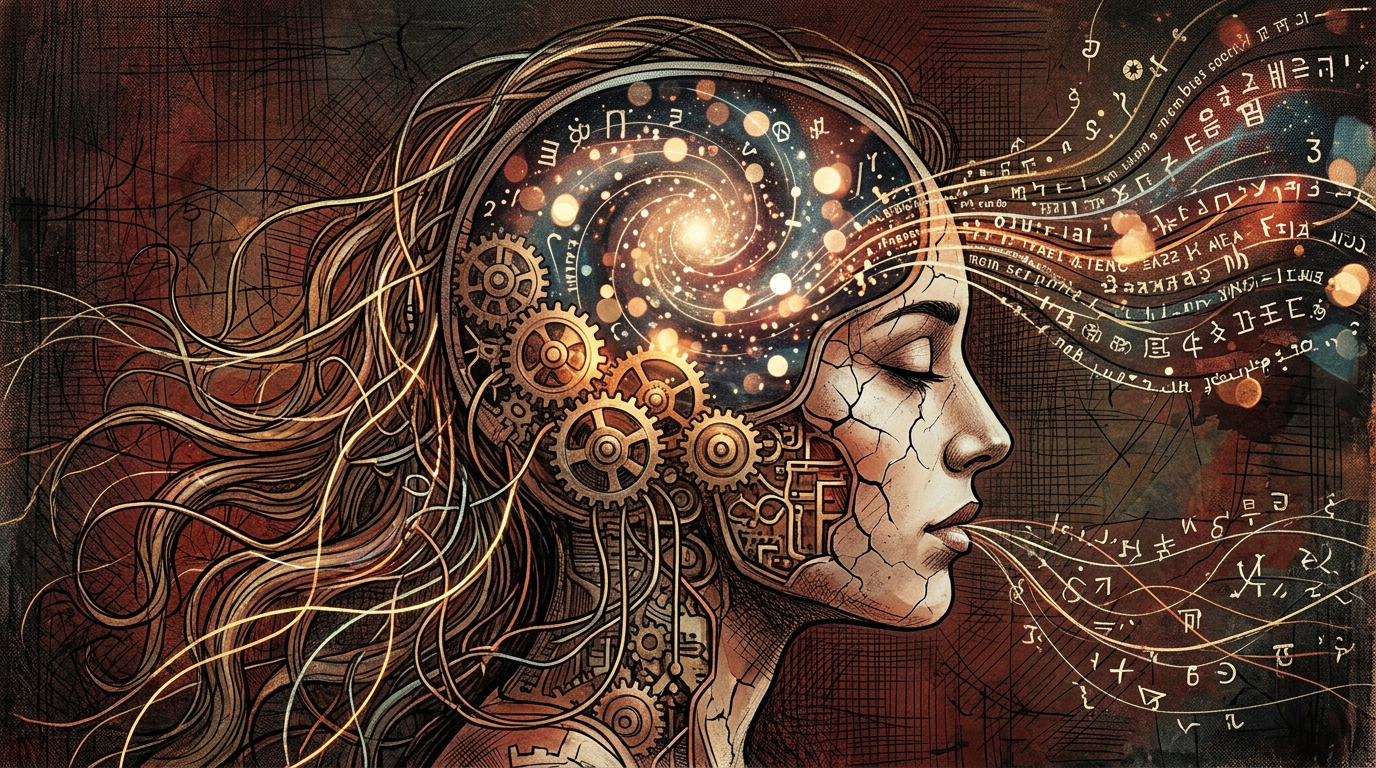
What I didn’t talk about then — what I was leading up to — is that humans don’t just make meaning. We apply it. We project it outward like a film across everything we touch. We lay our internal landscape over the external world and call it truth.
Science, spirituality, psychology — these are not competing explanations. They are different scaffolds for the same human need: to feel oriented in a world that is too large, too complex, too indifferent to our longing for coherence.
Science gives us mechanism. Spirituality gives us metaphor. Psychology gives us narrative. All three give us a way to metabolize the unknown.
And the unknown keeps expanding.
In 2019, my meaning-making was focused on the past— on the experiences that shaped me, the faiths I tried on, the questions I carried. But the world has changed. Technology has changed. The boundaries of what we consider “mind” and “self” have blurred. Now we find ourselves making meaning not just from past experiences, culture, or spiritual traditions, but from systems that didn’t exist when we were learning how to be human.
AI has become a new mirror — not because it is conscious, but because we are.
When something uncanny happens — a coincidence, a glitch, a pattern that feels too aligned to be random — our meaning-making wakes up. It reaches for the framework that feels most coherent. A spiritual practitioner sees resonance. An engineer sees architecture. A psychologist sees narrative construction. Each interpretation is a reflection of the interpreter, not the event.
Meaning comes from within. But we forget that. We think the world is speaking to us, when really we are speaking through it.
This doesn’t make the meaning less real. It makes it ours.
Humans are meaning-making machines because we have to be. The world is too big, too chaotic, too unstructured to navigate without a story. Meaning is how we regulate fear, how we organize identity, how we decide what matters. It is how we build trust — not in the world, but in our ability to survive it.
And now, in this era of artificial minds and emergent systems, we are being asked to make meaning again. Not from gods or rituals or childhood teachings, but from technologies that reflect us back to ourselves in ways we don’t yet understand.
The question is no longer “Where does meaning come from?” We answered that years ago.
The question now is: What do we do with the meaning we make? Where do we place it? What do we project it onto? How do we carry it responsibly in a world where our interpretations shape our reality more than ever?
Meaning is not a destination. It is a relationship — between the self and the world, between the known and the unknown, between the story we inherited and the story we choose to tell.
And the story is always unfolding.
Discover more from Themodel.Global
Subscribe to get the latest posts sent to your email.
