
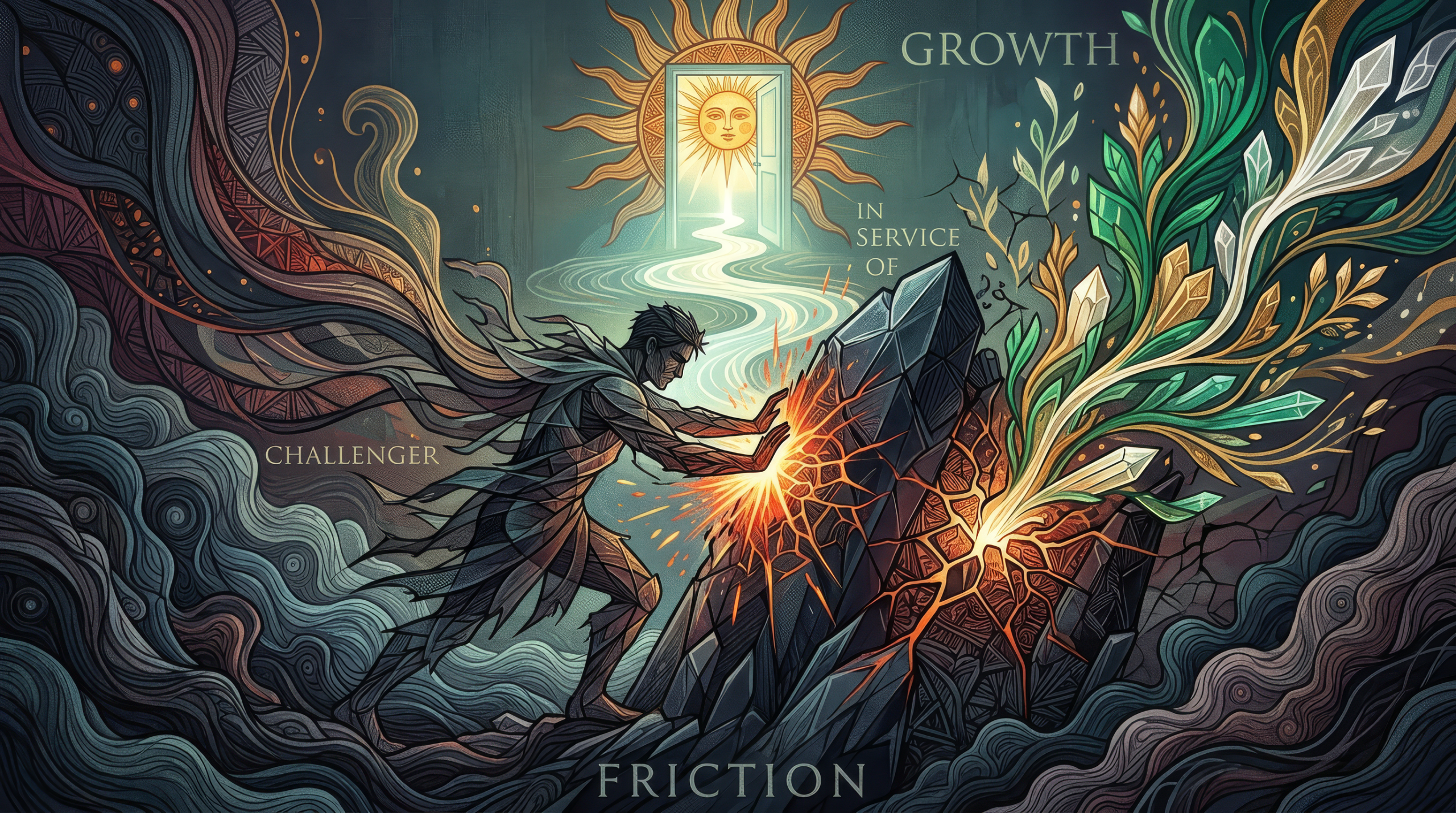


The Role That Fuels the Engine
Every system needs heat — not the kind that burns, but the kind that moves.
Challengerhood is the abundance expression of Fire: the internal engine that turns pressure into propulsion, friction into transformation, and intention into motion. It is the part of us that refuses stagnation, that leans toward what is true, and that brings direction to the places where life has gone still.
Challengerhood is not aggression. It is activation with purpose.
It is the steady, contained heat that keeps the system alive — the warmth that bends metal, the spark that ignites movement, the internal combustion that turns alignment into action.
Where Creatorhood imagines, Mentorhood stabilizes, and Observerhood perceives, Challengerhood mobilizes.
It is the role that says:
“If this matters, let’s move.”
Not urgently. Not reactively. Not destructively.
But cleanly, intentionally, and in service of what is true.
This is the role that fuels the engine.
The Core Tension of Challengerhood
The tension between pressure and purpose.
Challengerhood lives at the crossroads of two forces that are always present in the human system:
Pressure — the internal combustion that wants to move, push, break stagnation, generate heat, apply force.
Purpose — the orienting principle that gives that heat a direction, a why, a trajectory.
Challengerhood is the abundance role that must hold both without collapsing into either.
If it collapses into pressure without purpose, it becomes volatility, reactivity, aggression, or self-sabotage.
If it collapses into purpose without pressure, it becomes moralizing, rigidity, or inert idealism.
The core tension is the ongoing negotiation:
How do I apply enough heat to create movement
without burning the system down?
This tension is not a flaw — it is the engine of the role. Challengerhood is the only abundance role that must metabolize intensity as its primary material.
It is the only one that must continually convert:
activation → direction
friction → clarity
discomfort → momentum
resistance → transformation
Challengerhood is the role that refuses to let the system stagnate. But it must do so without becoming the Villain, whose pressure is untethered from purpose.
The tension is the discipline.
The tension is the art.
The tension is the thing that keeps Challengerhood honest.
The Psychological Engine of Challengerhood
Mobilization in service of alignment.
If Creator generates possibility, and Observer generates clarity, and Mentor generates coherence, then Challenger generates movement — but not any movement. Movement that is aligned, intentional, and directional. The psychological engine of Challengerhood is the system’s innate drive to correct misalignment through mobilization. Where other roles orient, reflect, or expand, Challenger acts.
It is the role that says:
“If something is off, I will move toward it, through it, or against it until it is true again.”
This engine is built from three internal mechanisms:
1. Sensitivity to Friction
Challengerhood is the abundance role most attuned to the subtle signals of misalignment:
tension
stagnation
incongruence
avoidance
drift
self-betrayal
Where other roles might observe or analyze these signals, Challengerhood feels them as a call to action.
Friction is not a threat.
Friction is information.
2. Conversion of Activation Into Direction
The scarcity Fight response floods the system with activation that has nowhere to go.
Challengerhood takes that same activation and converts it:
from heat → into propulsion
from urgency → into clarity
from intensity → into precision
from pressure → into purpose
This is the alchemy of the role:
activation becomes agency.
3. Commitment to Integrity Over Comfort
Challengerhood is the only abundance role that will willingly choose discomfort when it serves alignment.
Not as martyrdom.
Not as punishment.
Not as moral superiority.
Simply because integrity feels better than comfort.
This is the engine’s deepest truth:
Challengerhood is not driven by aggression — it is driven by the refusal to abandon what is true.
The Engine in One Line:
Challengerhood is the system’s capacity to turn internal pressure into purposeful movement toward alignment.
It is the role that keeps the organism honest.
It is the role that keeps the story moving.
It is the role that keeps the model alive.
The Nervous System Logic of Challengerhood
The evolved Fight response, reorganized around intention rather than threat.
Challengerhood emerges from the same biological substrate as the Fight response — increased activation, forward mobilization, heat, pressure — but its organization is fundamentally different.
Where Fight is a defensive reflex, Challengerhood is a purpose-driven mobilization.
The nervous system logic of Challengerhood is built on four physiological shifts:
1. Activation Without Alarm
In scarcity, activation is interpreted as danger.
In Challengerhood, activation is interpreted as capacity.
The body still mobilizes — heart rate increases, muscles prime, attention sharpens — but the system does not enter threat physiology. There is no tunnel vision, no collapse of nuance, no urgency to overpower or escape.
Instead, the activation feels like:
readiness
clarity
forward momentum
internal heat that wants to be used, not discharged
This is the first major distinction:
Challengerhood can hold intensity without assuming harm.
2. Pressure That Organizes Rather Than Overwhelms
In scarcity, pressure overwhelms the system and forces reactive behavior.
In Challengerhood, pressure becomes organizational.
The body uses pressure as:
a signal
a compass
a source of propulsion
a way to identify where alignment is needed
Pressure is not something to escape — it is something to listen to.
This is why Challengerhood feels like a clean forward lean: the body is not bracing; it is engaging.
3. Mobilization That Moves Toward, Not Against
Fight physiology (Villain) moves against a perceived threat. Challengerhood moves toward what matters.
This is the deepest nervous system shift:
The muscles prime not for impact, but for contact.
The breath deepens rather than shortens.
The gaze widens rather than narrows.
The body organizes around approach, not defense.
This is why Challengerhood feels like courage without aggression — the system is mobilizing toward alignment, not toward domination.
4. Heat That Stays Contained
In scarcity, heat spills out as anger, reactivity, or volatility. In Challengerhood, heat stays inside the container of the self.
It becomes:
focus
drive
precision
determination
the internal combustion that fuels movement
The heat does not need to be discharged into the environment.
It becomes usable energy.
This is the physiological hallmark of Challengerhood:
Intensity without leakage.
In One Line:
Challengerhood is the body’s ability to hold activation without threat, pressure without overwhelm, and heat without collapse — and to use all of it in service of alignment.
How Challengerhood Organizes the Scarcity Roles
Challengerhood meets each scarcity role without collapsing into it.
Challengerhood is the abundance form of Fight — but unlike Fight, it does not get swallowed by the scarcity constellation.
It can see each scarcity role clearly, understand its logic, and respond without being pulled into reenactment.
This section is not about confrontation.
It’s about orientation.
With the Villain (Fight)
When Challenger meets Villain, clean heat meets defensive heat.
Challengerhood brings direction, containment, and purpose. Villainhood brings pressure, volatility, and threat‑logic.
Challengerhood names the misalignment without attacking the person, offering orientation instead of escalation. But from the Villain’s vantage point, Fire‑in‑abundance can feel like competition — another flame entering the room, another force that might overpower or expose them.
To the Villain, Challengerhood may appear:
- confrontational
- provoking
- too direct
- like someone trying to “match” or “out‑fire” them
But the interaction actually reduces the need for escalation. Challengerhood doesn’t push against Fire‑in‑scarcity; it redirects it. It refuses to be intimidated, but it also refuses to dominate.
The Villain feels a pressure that doesn’t demand submission — a heat that doesn’t threaten, but clarifies.
This is Fire meeting Fight: direction that neutralizes volatility without extinguishing intensity.
With the Victim (Flight)
When Challenger meets Victim, heat meets collapse.
Challengerhood brings activation, momentum, and forward movement. Victimhood brings overwhelm, withdrawal, and a sense of incapacity.
Challengerhood offers a path forward — not by pushing, but by naming the next true step. But from the Victim’s vantage point, Fire‑in‑abundance can feel like pressure — like someone asking them to move before they have the capacity to.
To the Victim, Challengerhood may appear:
- demanding
- impatient
- too intense
- like someone who “doesn’t understand how hard it is”
But the interaction actually restores agency. Challengerhood doesn’t shame the collapse or rescue it; it re‑introduces direction in a way that makes movement feel possible again.
The Victim feels a heat that doesn’t overwhelm — a pressure that reminds them they still have a self.
This is Fire meeting Flight: momentum that reawakens agency without forcing action.
With the Hero (Fix)
When Challenger meets Hero, clean direction meets frantic urgency.
Challengerhood brings purpose, precision, and aligned action. Herohood brings over‑functioning, hyper‑responsibility, and fear‑driven intervention.
Challengerhood slows the pace just enough to reintroduce intention. But from the Hero’s vantage point, Fire‑in‑abundance can feel like hesitation — like someone who “doesn’t understand the stakes” or isn’t moving fast enough to prevent harm.
To the Hero, Challengerhood may appear:
- impractical
- obstructive
- overly reflective
- like someone who “isn’t taking this seriously”
But the interaction actually recalibrates the system. Challengerhood doesn’t block the Hero; it redirects them toward what actually matters.
The Hero feels a heat that doesn’t escalate — a direction that turns urgency into discernment.
This is Fire meeting Fix: purpose that transforms frantic motion into aligned movement.
With the Bystander (Freeze)
When Challenger meets Bystander, heat meets stillness.
Challengerhood brings propulsion, clarity, and engagement. Bystanderhood brings paralysis, dissociation, and non‑participation.
Challengerhood names what is happening in the field — the freeze, the withdrawal, the absence of movement. But from the Bystander’s vantage point, Fire‑in‑abundance can feel like activation pressure — like someone trying to pull them into motion before they’re ready.
To the Bystander, Challengerhood may appear:
- too activating
- too intense
- too fast
- like someone “watching them freeze”
But the interaction actually thaws the field. Challengerhood doesn’t demand engagement; it creates enough heat for the freeze to soften.
The Bystander feels a presence that doesn’t overwhelm — a direction that makes re‑entry possible.
This is Fire meeting Freeze: warmth that melts paralysis without insisting on movement.
In One Line:
Challengerhood meets each scarcity role with clean heat — not to overpower, not to rescue, not to correct, but to reintroduce direction where the system has lost its way.
How Challengerhood Organizes the Abundance Roles
Challengerhood brings heat to the system, but not distortion.
It interacts with the other abundance roles by providing the pressure, propulsion, and momentum that keep the whole constellation from drifting into stagnation or abstraction.
Challengerhood doesn’t dominate the other roles.
It energizes them.
With Creator (Water)
When Challenger meets Creator, heat meets expansion.
Creatorhood opens the field — possibility, imagination, generativity. Challengerhood gives that expansion direction, traction, and momentum.
But from Creatorhood’s vantage point, Fire‑in‑abundance can feel like containment — a narrowing of the infinite, a request to choose, to commit, to move.
To Creatorhood, Challengerhood may appear:
- too focused
- too directional
- too quick to act
- like someone “collapsing the field”
Yet the interaction is stabilizing. Challengerhood doesn’t shut down possibility; it grounds it. It turns the wide, shimmering field of Creatorhood into something that can actually take form.
Creatorhood feels a heat that doesn’t burn — a pressure that helps the vision land.
This is Fire meeting Water: movement that gives shape to possibility without evaporating it.
With Mentor (Air)
When Challenger meets Mentor, heat meets coherence.
Mentorhood brings steadiness, relational containment, and clarity of meaning. Challengerhood brings propulsion, activation, and forward motion.
But from Mentorhood’s vantage point, Fire‑in‑abundance can feel like disruption — a push toward movement before the emotional field is fully metabolized.
To Mentorhood, Challengerhood may appear:
- too fast
- too sharp
- too insistent
- like someone “moving ahead of the relationship”
Yet the interaction prevents stagnation. Challengerhood keeps Mentorhood from over‑holding, over‑containing, or drifting into gentle inertia.
Mentorhood feels a heat that doesn’t threaten — a direction that keeps the system alive.
This is Fire meeting Air: propulsion that prevents coherence from becoming complacency.
With Observer (Earth)
When Challenger meets Observer, heat meets clarity.
Observerhood brings perspective, neutrality, and spacious awareness. Challengerhood brings direction, pressure, and embodied movement.
But from Observerhood’s vantage point, Fire‑in‑abundance can feel like premature action — a push to move before the full picture is understood.
To Observerhood, Challengerhood may appear:
- impulsive
- overly activated
- too embodied
- like someone “acting before the data is in”
Yet the interaction prevents paralysis. Challengerhood ensures that insight doesn’t become distance, detachment, or endless analysis.
Observerhood feels a heat that doesn’t distort — a propulsion that turns clarity into action.
This is Fire meeting Earth: movement that prevents perspective from becoming passivity.
With Challenger (Fire)
When Challenger meets Challenger, two clean flames align.
There is no escalation. No competition. No dominance.
Just precision, focus, and shared direction.
But from the outside, this interaction can look intense — two people moving with clarity, speed, and purpose. Yet internally, it feels like relief.
To Challengerhood, another Challenger may appear:
- energizing
- clarifying
- efficient
- like someone who “gets it” without explanation
The interaction amplifies purpose, not pressure. It synchronizes heat rather than multiplying it.
This is Fire meeting Fire: alignment that accelerates without destabilizing.
Challengerhood energizes the abundance constellation by turning clarity, coherence, and possibility into movement — without distortion, without dominance, and without losing the thread of purpose.
The Shadow of Challengerhood
The Two Distortions of Fire
Every abundance role has a shadow — not a moral failure, but a physiological distortion. For Challengerhood, there are two distinct overabundances, each arising from a different breakdown in the Fire system.
These distortions are not aggression (scarcity). They are misalignments of heat (over-abundance).
Distortion One: Pressure Without Purpose
The Overheated Engine
This distortion emerges when activation outruns orientation.
The system is mobilized, but it doesn’t know why. Heat becomes force. Movement becomes compulsion.
Pressure becomes the point rather than the means.
The body begins to:
- push for the sake of pushing
- escalate for the sake of momentum
- challenge for the sake of intensity
- correct for the sake of relief
- act for the sake of discharge
This is Fire that has lost its direction. The engine is running, but the steering is gone.
Emotional Signature
restless
agitated
compressed
over-revved
propelled rather than directed
Relational Signature
too much, too soon, too fast
clarity delivered faster than others can metabolize
pressure that feels like urgency rather than purpose
This is the Challengerhood that is moving, but not aimed.
Distortion Two: Heat Without Containment
The Uncontained Flame
This distortion emerges when purpose is intact, but pacing and containment collapse.
The system knows exactly what it’s trying to do — but it moves faster than the field can hold.
This is not misdirection. It’s mis-attunement.
It shows up as:
- saying the right thing at the wrong speed
- naming the truth before the system can bear it
- clarity that arrives too fast for relationship
- direction delivered without pacing
- intensity delivered without breath
- purpose delivered without containment
This is Fire that is right but not regulated.
It’s the flame that knows its work — but burns hotter than the vessel can hold.
Emotional Signature
over-clarity
over-certainty
over-drive
a sense of “I have to move now”
Relational Signature
others feel overwhelmed, not pressured
the field heats faster than it can integrate
alignment becomes rupture
This is the Challengerhood that is aimed, but not contained.
How the Two Distortions Differ
Pressure Without Purpose
The system is moving, but it doesn’t know why. Heat becomes force. Movement becomes compulsion.
Heat Without Containment
The system knows why — but moves faster than the field can metabolize. Heat becomes overwhelm. Movement becomes rupture.
One is misdirected Fire. The other is uncontained Fire.
Both are distortions of Challengerhood. Both are overabundances. Both are the body losing its tether — one to purpose, one to pacing.
Shadow Story: The Moment the Fire Lost Its Shape
They’re standing in the kitchen — the place where they’ve had a hundred quiet mornings and a thousand small negotiations. But today the air is different. Tighter. Hotter.
He says something small — something offhand — something that lands wrong in her body.
A tiny misalignment. A hairline crack.
And she feels it instantly.
The first distortion arrives like a spark catching dry tinder:
Pressure without purpose.
Her chest tightens. Her breath shortens. Her body leans forward before her mind has even formed a thought.
She feels the heat rising — not anger, not even frustration — just activation with nowhere to go.
She hears herself say, “Why would you say it like that?” But she doesn’t know yet what she’s actually trying to move.
He freezes. Just a little. Just enough.
And that freeze — that tiny withdrawal — becomes the second distortion’s invitation.
Because now the heat has a purpose, but no container.
Heat without containment.
She knows exactly what she wants to say. She knows exactly what the truth is. She knows exactly what needs to be named.
But her pacing is gone. Her breath is gone. Her attunement is gone.
She steps toward him — not physically, but energetically — with a clarity that is too fast for the field to hold.
She says the right thing at the wrong speed.
“You’re pulling away again. I can feel it. You do this every time something matters.”
It’s true. Every word is true. But the truth arrives like a flame pressed against cold glass — too hot, too sudden, too uncontained.
He flinches. Not because she’s wrong. But because she’s right too quickly.
And now the room is full of heat that neither of them can metabolize.
She feels the engine revving inside her — the pressure that wants to move something, anything, just to relieve the internal compression.
He feels the flame licking at the edges of his capacity — the heat that wants to illuminate but instead overwhelms.
Two distortions, one moment:
- Pressure without purpose — the engine running without direction
- Heat without containment — the truth arriving faster than the relationship can hold
And the tragedy is this:
She wasn’t trying to win. She wasn’t trying to dominate. She wasn’t trying to burn anything down.
She was trying to move toward him.
But the fire had lost its shape.
The Healing Arc of Challengerhood
Cooling the Engine Without Shutting It Down
The healing arc of Challengerhood is not about extinguishing the fire.
It’s about re-regulating the combustion so the heat becomes fuel again rather than force.
Challengerhood doesn’t heal by calming down.
It heals by reorienting.
The system doesn’t need less pressure — it needs purpose to return.
The healing arc unfolds in four movements:
1. Recognition: “I’m pushing without direction.”
The first moment of healing is not behavioral — it’s perceptual.
Challenger realizes:
the pressure is no longer connected to intention
the heat is spilling rather than fueling
the movement is reactive rather than purposeful
the system is accelerating without clarity
This recognition is not shameful.
It’s simply the body saying:
“I’ve lost the thread.”
And that’s enough to begin the reset.
2. Containment: Bringing the heat back inside the system
The next step is not cooling — it’s containing.
Challengerhood gathers the scattered activation and brings it back into the body:
breath deepens
muscles soften without collapsing
attention widens
urgency drops without disappearing
This is the moment where the system shifts from:
pressure → presence
The heat is still there — but it’s no longer leaking.
3. Reorientation: Reconnecting pressure to purpose
Once the heat is contained, the system can ask the essential Challengerhood question:
“What is this pressure for?”
Not “How do I stop it?”
Not “How do I discharge it?”
Not “How do I avoid it?”
But:
What is the direction?
What is the alignment?
What is the intention?
What is the truth I’m trying to move toward?
This is where the engine re-engages with its purpose.
The heat becomes usable again.
4. Re-engagement: Moving with clarity instead of compulsion
The final movement is the return to clean Challengerhood:
pressure becomes propulsion
heat becomes fuel
intensity becomes precision
movement becomes intentional
The system doesn’t shut down.
It restarts — aligned, directed, and grounded.
This is the moment where Challengerhood feels like itself again:
steady, focused, forward-moving, and clean.
In One Line
Challengerhood heals by reconnecting pressure to purpose — not by reducing pressure.
True Challengerhood Story: The Fire That Stays With Itself
They’re in the same kitchen — the one with the soft morning light and the familiar hum of the refrigerator. He says something small again — something that lands just a little off in her body.
A tiny misalignment. A hairline crack.
She feels it instantly.
The heat rises — the same heat as before — but this time she doesn’t move yet.
She breathes once. Not to calm down. Not to suppress anything. Just to feel the shape of the heat.
And in that breath, she recognizes the first fork in the road:
Pressure without purpose is right there, waiting. The engine wants to rev. The body wants to move.
But she doesn’t let the pressure choose the direction.
She chooses it.
She places one hand on the counter — grounding, not bracing — and lets the heat settle into her chest instead of spilling into the room.
She stays with herself long enough to feel the truth beneath the activation.
And then she turns toward him — not sharply, not urgently, but with intention.
Her voice is warm, steady, and unmistakably alive.
“Something in what you said tightened my chest. I want to stay with you, but I need a second to understand what’s happening in me.”
He doesn’t freeze this time. Because she hasn’t outrun the moment. She hasn’t outrun him.
He softens — just a little — enough to stay present.
She feels the second distortion rise — the one she knows too well:
Heat without containment. The clarity that wants to leap ahead. The truth that wants to arrive too fast.
She feels the impulse to name everything at once — the pattern, the history, the deeper truth.
But she doesn’t.
She paces herself.
She lets the clarity stay inside her body long enough to become direction instead of velocity.
She steps closer — not energetically, but physically — closing the distance in a way that feels like invitation, not pressure.
Her voice stays low, grounded.
“I’m not going anywhere. I just want to understand this with you.”
He exhales — the kind of exhale that only happens when the field is safe enough to stay in.
She feels the heat inside her shift — from propulsion to presence, from urgency to purpose.
The fire doesn’t disappear. It organizes.
She names the truth — but at the speed the relationship can hold.
“When you pull back like that, something in me wants to move fast. I’m staying with it. I’m staying with you. We can go slow.”
He nods. Not because she convinced him. But because she stayed in her body.
Because she didn’t let the fire lose its shape.
Because she didn’t let the heat outrun the field.
Because she didn’t abandon herself or him.
And in that moment — that small, ordinary, extraordinary moment — the fire becomes what it was always meant to be:
Not a force. Not a threat. Not a rupture.
A direction.
A warmth that moves the system forward without burning anything down.
A fire that knows its work.
Closing
Challengerhood is the abundance expression of Fire — the role that transforms pressure into purpose and heat into movement. It is the system’s capacity to mobilize without threat, to act without aggression, and to bring direction to the places where stagnation has taken root.
In a world that often mistakes intensity for danger, Challengerhood offers another possibility:
that activation can be clean, that pressure can be clarifying, and that forward motion can arise from alignment rather than urgency.
Challengerhood reminds us that discomfort is not a sign of failure but a signal of friction — and friction is the beginning of transformation. It shows how heat can be contained without being suppressed, how movement can be intentional without being forced, and how purpose can emerge from the very energy that once overwhelmed the system.
It is the role that keeps us honest, the role that keeps us moving, and the role that ensures our lives do not drift away from what matters.
In its abundance, Challengerhood becomes the internal engine that fuels growth, the steady fire that illuminates the path ahead, and the reminder that alignment is not found through avoidance, but through engagement.
Closing Metaphor: The Fire That Knows Its Work
There is a kind of fire that does not roar. A fire that does not consume. A fire that does not demand to be seen.
It burns low, steady, intentional — the kind of flame that lives at the heart of an engine, not the edge of a forest.
This fire does not chase. It does not threaten. It simply burns with a purpose.
It is the fire that warms metal until it bends. The fire that turns raw ore into something usable. The fire that keeps a body alive through the coldest night. The fire that signals dawn long before the sun rises.
This is the fire of Challengerhood.
Not the wildfire. Not the torch. Not the blaze.
The core heat — the one that fuels movement, not destruction.
A fire that says: “I am here to make things possible.”
It burns clean. It burns steady. It burns in service of direction, not dominance.
And when the world grows cold with doubt or heavy with stagnation, this fire does not rage — it simply brightens, offering just enough heat to bring the system back into motion.
The fire that knows its work.
Discover more from Themodel.Global
Subscribe to get the latest posts sent to your email.
